
Rigid multilayer PCBs, engineered for the stack-ups others decline
Two to thirty layers with backdrilling, heavy copper and impedance control. Volume runs at Zhongshan; the difficult first articles run in Shenzhen where the process engineers sit.
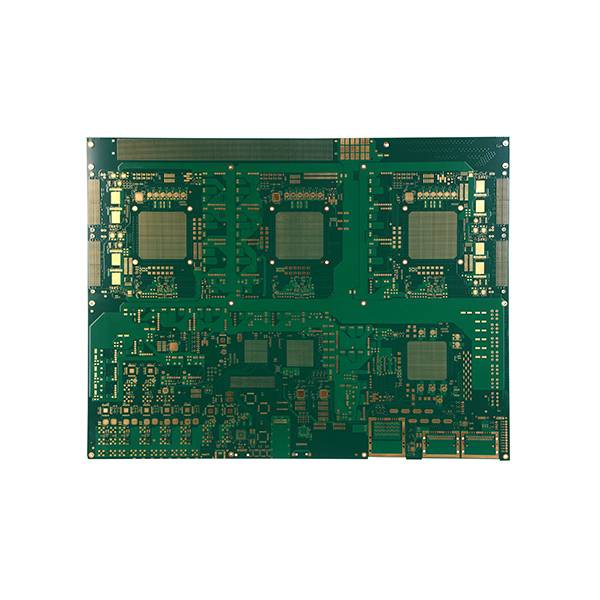
At a glance
- Zoran produces rigid multilayer boards from 2 to 26 layers in volume, with 30 layers proven in production.
- Standard line and space is 3/3 mil (0.075 mm); 2/2 mil (0.05 mm) is quoted after engineering review.
- Impedance is controlled to ±10% as standard and ±5% on request, verified by test coupon on every impedance order.
- Backdrilling, blind and buried vias, heavy copper to 8 oz and stepped slots run on the same lines as standard product.
- Rigid volume is manufactured at the Zhongshan plant (70,000 m² per month); prototypes and NPI run in Shenzhen.
What we can hold, in numbers
Standard means it runs every week. Best-in-class means we have shipped it and will quote it after review.
Surface finishes: HASL (lead-free and leaded), ENIG, OSP, immersion silver, immersion tin, hard gold, carbon, and selective combinations such as ENIG + OSP.
Where the yield actually comes from
Backdrilling on high-layer backplanes
Sixteen-layer and above backplanes are backdrilled to remove unused via stubs, with depth control held to ±0.075 mm (±0.025 mm best). Stub control is what keeps 10 Gbps+ signals from turning into a rework story.
Heavy copper without edge shorting
Inner layers to 5 oz and outer layers to 8 oz, with etched clearance adjusted per copper weight. Power boards and coin-embedded assemblies are quoted with a dedicated plating route rather than forced through standard panel plating.
Impedance held across the panel
±10% standard, ±5% on request, verified on coupons from the same panel. FR-4, Rogers and Arlon stacks are modelled before release, so the first article is not the experiment.
Registration on 20-plus layer builds
Layer-to-layer registration of 0.10 mm standard and 0.075 mm best, using target-based tooling holes and per-layer scaling. This is the difference between a 20-layer board that passes AVI and one that scrapes through.
Mixed lamination
FR-4 combined with Rogers, Taconic or aluminium in one build, including hybrid stack-ups where only the RF layers change material. Delamination at the interface is controlled by press profile, not hope.
Special geometry
Stepped slots, countersunk holes, half-holes, board-edge plating, long-short gold fingers and precision carving, all handled in-house rather than subcontracted.
Materials
TUC, ITEQ, Nanya, SYL, Isola, Rogers, Arlon, Nelco, Panasonic MEGTRON 6
Thickness range
0.3–4.0 mm standard, 0.2–5.0 mm on review
Copper weight
3 oz inner / 6 oz outer standard, 8 oz on review
Reports shipped
Impedance, microsection, solderability, ionic contamination, bow & twist
Lead time, by layer count
Working days from data and purchase order release. Volume above 10 m² is quoted through the quick-turn channel.
| Layers | <1 m² | 1–5 m² | 5–10 m² |
|---|---|---|---|
| 2–4 layers | 5 | 7 | 10 |
| 6 layers | 8 | 10 | 14 |
| 8 layers | 8 | 12 | 14 |
| 10–12 layers | 10 | 12 | 14 |
| 16 layers | 15 | 17 | 20 |
| 20 layers | 20 | 22 | 25 |
What we need to quote
Gerber (RS-274X or ODB++), layer count, board size, quantity, material, copper weight, surface finish and any impedance requirement. Missing information is not a blocker — an engineer will ask within the four-hour quote window.
- Standard RFQ response: 4 working hours
- Engineering query response: 8 working hours
- NDA signed before files are reviewed, on request
- First article report available on prototype orders
What buyers ask before the first order
Can you produce 30-layer boards in volume, or only as a sample?
Thirty layers is a proven capability, not a laboratory claim — it runs with the same documentation and test regime as lower layer counts. For stack-ups above 26 layers we ask for the design before quoting, because laminate availability and press cycles affect both the price and the lead time.
How is impedance controlled if we do not specify the stack-up?
We propose the stack-up, calculate the trace geometry, and confirm it with you before release. Coupons from the same panel are measured and the report ships with the boards. If you supply your own stack-up, we check it against the material we hold and flag anything that cannot be built to ±10%.
Do you accept small prototype quantities?
Yes. There is no fixed minimum order quantity. Five-piece prototype orders run through the same process control as production, and ship in five working days for 2–4 layer boards.
What happens if the boards fail incoming inspection?
Non-conformance is handled against the specification agreed at PO, including microsection and impedance data. We replace or credit per the agreed terms, and issue a written root-cause report for any repeat failure — the report matters more than the credit.
Send the stack-up. We will tell you if it can be built.
Gerber, layer count and quantity is enough to start. Engineering review comes before pricing, not after.